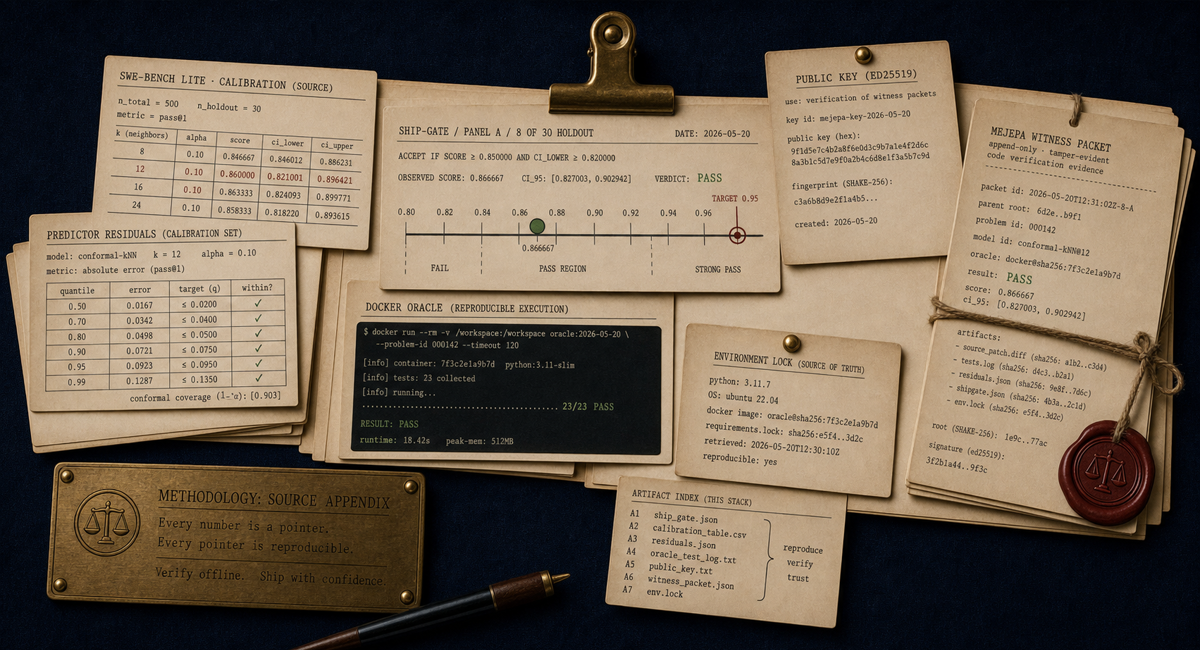
Methodology · ship-gate math · refreshed 2026-05-20
The math behind the gate.
Mejepa ships when prediction-oracle Pearson correlation ρ ≥ 0.95, stable across four rolling windows, per cell.
Current ρ = 0.866667. Here is how the number is computed, what it is measured against, and how an outside auditor can replay it.
THE GATE
One metric. Four windows. Eleven cells.
ρ ≥ 0.95
Pearson correlation threshold
Computed across all 300 SWE-bench Lite tasks. Single training window.
4×
Consecutive rolling windows
Four training cycles each must independently exceed the threshold. One high window does not fire the gate.
11 × N
Per-cell stratification
11 mutation categories × N supported languages. Every cell must independently pass. Ship with Python; expand language by language.
The computation
For each SWE-bench Lite task i, Mejepa emits a predicted oracle pass probability pi ∈ [0, 1].
The actual oracle outcome yi ∈ {0, 1} is determined by running the patched repository against the official Docker test suite — the exact procedure published by Princeton NLP for SWE-bench.
Pearson ρ = Cov(p, y) / (σp σy) is computed across the full 300-task set.
The same ρ is computed for each (mutation_category × language) cell independently — 11 mutation categories, 1 language at ship time.
The gate fires when both the aggregate ρ and every per-cell ρ exceed 0.95, repeated for four consecutive training windows.
Mutation-category stratification
Mejepa stratifies SWE-bench Lite tasks into binary-doctrine mutation categories so the predictor cannot pass the gate by being strong on the common categories and weak on the rare ones. Q4 surfaces (performance regressions, reasoning-class, latent-bug subjective grading) are formally retired as wontfix-ambiguity-boundary . The list below is the FSV-bounded subset:
The full canonical mutation taxonomy resolves through the panel-slot ↔ failure-mode mapping in the FSV plan §1.1 + §1.4. The list above is illustrative; the binding taxonomy is the registry, not this enumeration.
WHY THIS NUMBER, NOT ANOTHER
SWE-bench Lite, not Verified, not SWE-bench+.
SWE-bench has three published variants and we picked one deliberately:
SWE-bench full — 2,294 tasks. Too large for tight iteration cycles; coverage is non-uniform across mutation categories.
SWE-bench Verified — 500 tasks, hand-filtered for tractability. Useful but narrower; filters out the failure modes Mejepa most needs to grade.
SWE-bench Lite — 300 tasks. The OpenReview SWE-Bench+ paper showed that 47.93% of "resolved" instances passed weak tests but were actually broken on stronger ones, which is exactly the failure class Mejepa exists to catch.[1]
SWE-bench Lite has wider mutation-category coverage, a published community baseline, and a clear failure-mode taxonomy. It is the benchmark a deterministic verifier must beat to claim it is not just another LLM judge.
CONFORMAL CALIBRATION
An honest verdict, not a confident one.
The ship-gate ρ measures point-prediction accuracy. The verdict itself uses a separate calibration step: split conformal prediction.
Reserve 20% of the corpus as a calibration set, stratified per cell.
For each calibration point, compute the residual |pi − yi|.
Sort residuals; pick the 95th percentile q0.95.
At inference time, emit the interval [p − q0.95, p + q0.95].
If the interval contains 0.5, the verdict is Abstain — neither Pass nor Fail can be claimed with 95% coverage.
If the patch's embedding sits more than τ standard deviations from any cluster centroid, the verdict is OutOfDistribution regardless of the interval.
Conformal prediction is what gives Abstain a mathematical floor. It is not a heuristic; it is a coverage guarantee. Reference: Vovk, Gammerman, Shafer, Algorithmic Learning in a Random World (Springer, 2005).
OpenReview — SWE-Bench+: Enhanced Coding Benchmark for LLMs (2025). 47.93% of "resolved" instances passed weak tests but were not actually correct; resolution rate drops from 42.1% to 21.8% after filtering plausible-but-broken patches.
Vovk, Gammerman, Shafer — Algorithmic Learning in a Random World. Springer, 2005. Foundational text on conformal prediction.
LeCun — A Path Towards Autonomous Machine Intelligence (2022). The JEPA position paper. openreview.net
Panel A is measured weekly on the 8/30 holdout. Panel B (cross-panel, #405) is the sole p0 blocker. There is no "soon" — the gate fires when the number fires.