Trust & Proof · FSV §1.1, §1.2, §1.8
Trust the chain, not the Oracle.
Every verdict the Oracle emits is signed with ed25519 and chained with SHAKE-256. The public key is published. The chain is replayable offline in roughly 30 seconds. You do not have to trust us to confirm what the Oracle saw — the math, the Docker container, and the public key are enough. A real Oracle shows you how to check her. Below: how the chain works, the live ship-gate, and the fences the Oracle holds on purpose.
The witness chain
Five signed witness types · one append-only chain
The chain links five witness types: verdicts, panel states, training certificates, feedback events, audit events. Each link carries the previous link's SHAKE-256 hash, so tampering with any historical record breaks every subsequent signature. Verification needs only the public key — Mejepa servers are not on the trust path.
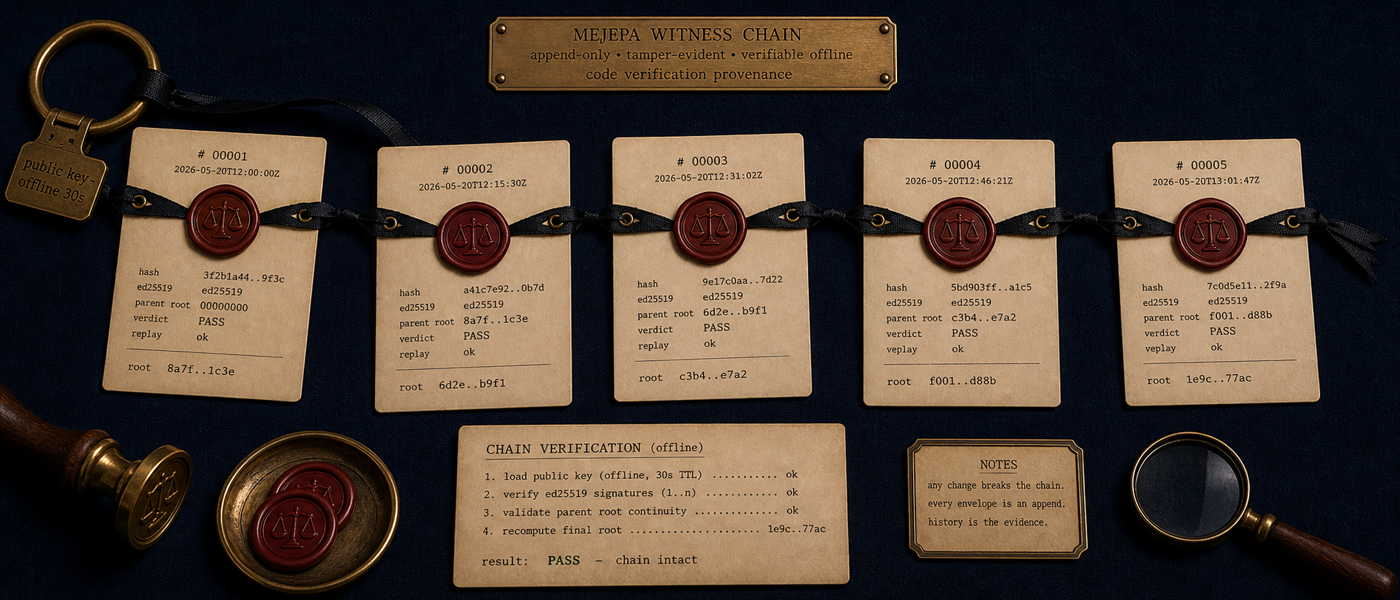
What a verdict packet contains
- The patch SHA-256 + base file SHA-256
- The verdict: Pass, Fail, or Abstain (with OOD reason if applicable)
- The Docker oracle
report.jsonSHA-256 — anyone can re-run the container and confirm independently - The named failure mode on Fail or Abstain
- The closest historical exemplar (id + cosine distance from the 491-row registry )
- The panel state hash (15 slots, SHAKE-256)
- The conformal interval
- An ed25519 signature
- The previous chain link's SHAKE-256 hash and this link's SHAKE-256 hash
How to replay offline
- Download the chain from the pilot delivery (today: handed over with the engagement; post-ship-gate: from the buyer's verdict store).
- Fetch the public key from
https://mejepa.com/keys. - Run the offline replay tool. It walks every link, verifies every signature, and confirms no record was tampered with.
The live ship-gate
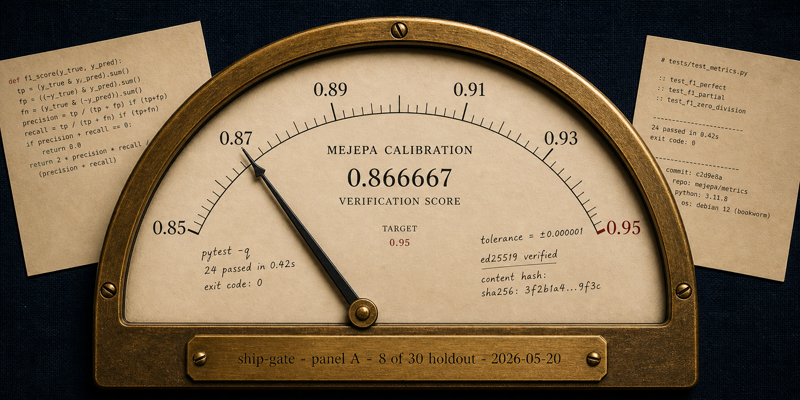
Panel A: 0.866667 → target 0.95
We measure the same number every week on the same 8-of-30 holdout from the SWE-bench Lite 300 × 8 corpus. The gap to ship-gate green is 0.083 correlation points on Panel A. Panel B (cross-panel, non-overlapping encoders — issue #405) is unmeasured and is the sole p0 blocker . There is no "soon." The gate fires when the number fires.
What Mejepa is NOT today · verbatim from FSV §1.8
Pre-production · No SLA · No hosted service today · Python-only at ship-gate · FSV §1.8
The fences, named
- Not a generative inference engine. No inner LLM. The product is the verifier, not a code-writer.
- Not a benchmark harness.
- Not a hosted service. Runs locally on operator hardware (aiwonder for production).
- Not a Python codebase. Python only shows up as the corpus subject and in tool wrappers.
- Not cross-language at ship-gate time. Current gate is Python-only.
- Not HTTP-callable from action paths.
Plus, from the API stability statement: "ME-JEPA-Code is pre-production (no SLA, no backwards compatibility). Schema changes → wipe and rebuild. Future: TBD post-ship-gate."
If a vendor says "Mejepa is a hosted SaaS today" or asks for "Mejepa for non-code AI outputs," they are speaking ahead of the FSV plan. The honest answer for those surfaces is on the roadmap page: science risk, not engineering risk.